On a warm evening in Madrid, what was meant to be a joyful celebration quickly transformed into the kind of gathering that would fuel days—perhaps weeks—of speculation across Spanish television and gossip columns. The occasion was a birthday party hosted by well-known television presenter Emma García, a familiar face to viewers who follow Spain’s talk-show circuit. Friends, colleagues, and personalities from across the country’s entertainment industry arrived dressed for celebration. Cameras were absent, but the people present knew that in their world, stories rarely stay private for long.
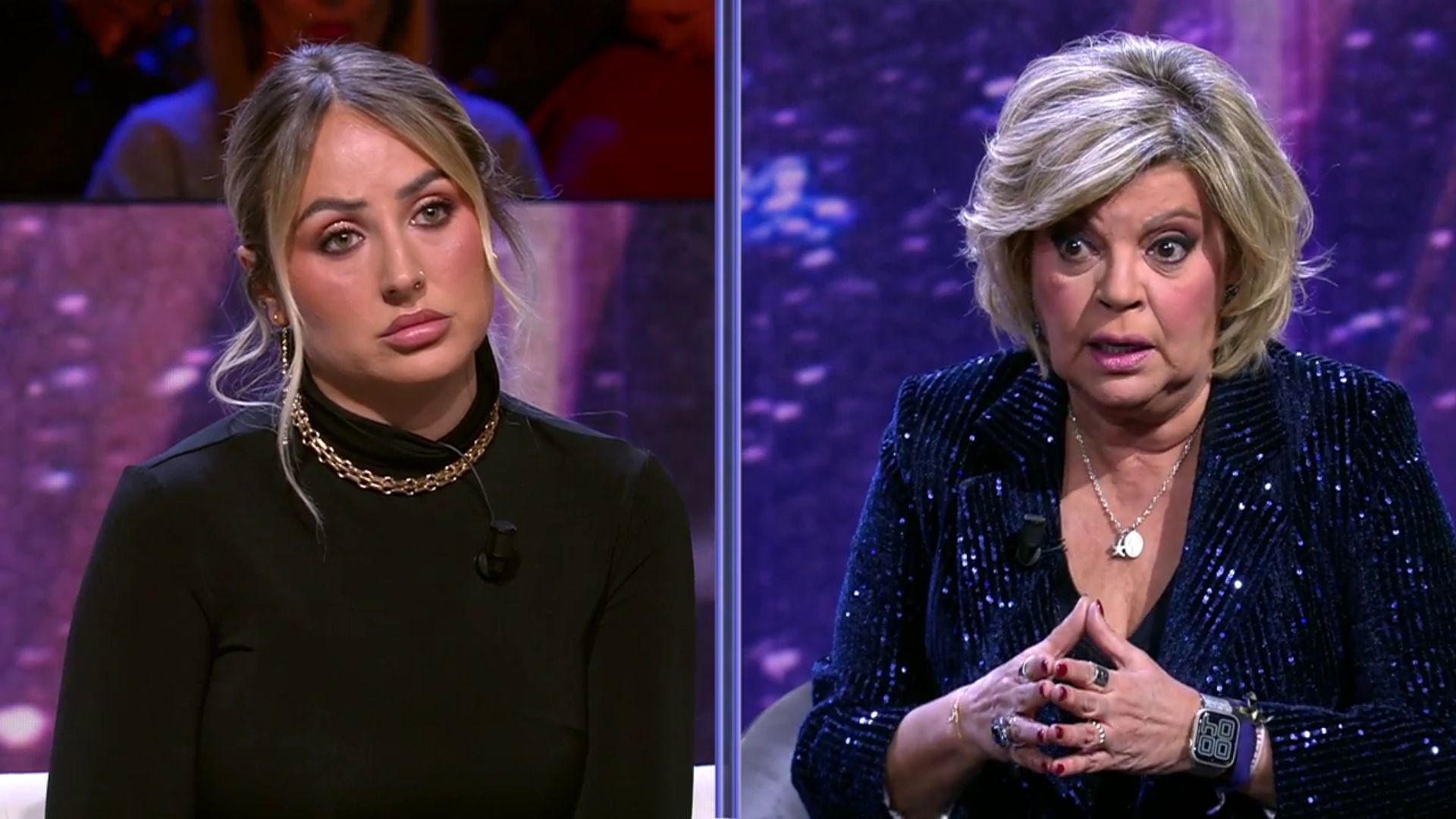
Among the guests was Rocío Flores, a figure who has long lived under the spotlight due to her family’s complicated history in Spanish media. She entered the party with quiet confidence, greeting acquaintances and exchanging brief embraces. To many observers, her presence alone was enough to raise curiosity. Whenever Flores appears in the same space as members of another well-known television family, tensions can quietly simmer beneath the surface.
Also present that night were two familiar figures in Spanish entertainment journalism: Terelu Campos and Carmen Borrego, sisters who have spent decades navigating the volatile world of television commentary and celebrity debate. Their mother, the late television icon María Teresa Campos, had built a formidable media legacy, one that both daughters carried forward through talk shows, interviews, and panel discussions that often dissected the personal lives of Spain’s most famous families.
For years, the names of Flores and the Campos sisters had circulated through the same ecosystem of television debates, rumors, and unresolved tensions. Yet public confrontations between them had been rare in recent times—at least until that evening.
A Celebration That Drew the Industry Together
The party itself was meant to be simple: a relaxed gathering among friends to celebrate Emma García’s latest professional milestone. García, who had hosted numerous popular programs over the years, was admired by colleagues for her calm presence and ability to moderate heated discussions on television.
Her guest list reflected that reputation. Producers, presenters, journalists, and reality-television personalities mingled beneath warm lights in a stylish venue in Madrid’s center. Conversations drifted from work to family to the endless rumors that circulate through Spain’s celebrity press.
At first, nothing about the night hinted at conflict.
Guests posed for casual photos, glasses clinked in quiet toasts, and music played softly in the background. Some attendees shared stories about the chaotic world of television production, laughing about live broadcasts that had gone wrong or interviews that had spiraled into drama.
But as the evening unfolded, subtle currents began to emerge.
An Unexpected Encounter
Witnesses later described the moment as almost accidental. Rocío Flores had been speaking with a small group near the bar when Terelu Campos and Carmen Borrego arrived in the same area. The space grew quieter, not because anyone raised their voice, but because several guests recognized the significance of the encounter.

In Spain’s entertainment media, relationships between families can carry decades of history. The Flores name alone evokes a complex web of personal stories tied to television debates and public controversies.
For a moment, the three women simply acknowledged each other.
Some attendees expected polite greetings and nothing more. After all, the event belonged to Emma García, and few guests wanted to create a scene during her celebration.
But according to several people present, Rocío Flores soon made a remark that shifted the tone of the conversation.
Words That Reopened Old Wounds
What exactly was said remains disputed. Different guests recall slightly different phrasing, yet the essence of the comment appears consistent: Flores suggested that certain television commentators had built careers discussing other people’s private lives while rarely acknowledging their own controversies.

It was not an accusation spoken loudly. Rather, it was delivered in a calm tone that many present interpreted as deliberate.
Terelu Campos reportedly responded first, questioning whether Flores was referring to her or her sister. Carmen Borrego, known for her sharper style of debate on television panels, quickly joined the exchange.
The conversation did not escalate into shouting, but witnesses say the tension in the room became unmistakable.
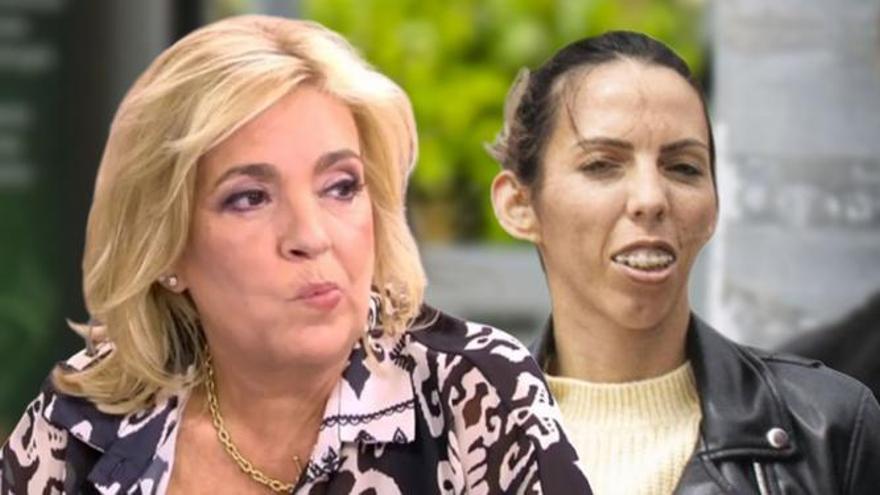
In Spain’s entertainment world, where many conflicts unfold in studio debates rather than private gatherings, the setting made the moment especially striking.
Paola Olmedo’s Presence
Adding another layer to the evening was the presence of Paola Olmedo, who had been speaking with Flores earlier in the night. Olmedo, herself no stranger to media attention, reportedly remained nearby as the conversation between Flores and the Campos sisters developed.

Some guests later speculated that Olmedo’s presence emboldened Flores, giving her confidence to address issues that had lingered unspoken for years.
Others insist the exchange was far less dramatic than rumors suggest.
Still, in an industry where even minor comments can ignite television debates, the moment quickly became the subject of intense discussion among those present.
A History of Media Rivalries
To understand why the encounter generated so much attention, one must consider the broader context of Spain’s celebrity media culture.
For decades, television talk shows have served as arenas where journalists, commentators, and personalities dissect the lives of public figures. Stories about families, relationships, and personal conflicts often become the center of televised discussions.
Both the Campos sisters and Rocío Flores have spent years appearing in programs where such topics are debated.
This environment creates unusual dynamics: individuals may criticize each other on television while maintaining polite relationships in private settings. Yet occasionally those boundaries collapse.
According to one guest who observed the interaction at Emma García’s party, the conversation felt like “a moment when television reality suddenly entered real life.”
Emma García Steps In
As host of the event, Emma García reportedly noticed the growing tension and moved to gently redirect the mood of the evening.
Friends say she approached the group with a smile, changing the subject and encouraging everyone to return to the celebration. Music was raised slightly, drinks continued to flow, and other guests began sharing stories to diffuse the atmosphere.
In many ways, García’s intervention reflected the skills that had made her successful on television: the ability to calm a heated exchange before it spiraled into full conflict.
Those present say the strategy worked.
Within minutes, conversations shifted again, and the gathering resumed its earlier rhythm.

The Morning After
Yet as often happens in Spain’s tightly interconnected entertainment world, the story did not remain confined to that room.
By the following morning, whispers about the encounter had begun circulating among journalists and television producers. Text messages passed between reporters asking the same question: what had really happened at Emma García’s party?
Some versions of the story portrayed the exchange as a dramatic confrontation. Others described it as nothing more than a pointed remark followed by a brief discussion.
The truth likely lies somewhere in between.
Silence and Speculation
Neither Rocío Flores nor the Campos sisters immediately addressed the reports publicly. Their silence only fueled speculation.
Television programs began discussing the possibility that old tensions had resurfaced. Panelists debated whether Flores had intentionally provoked the exchange or whether the conversation had been exaggerated by witnesses eager for drama.
For viewers accustomed to Spain’s lively media debates, the situation felt almost inevitable. When personalities whose histories intersect with years of televised commentary meet in the same room, the potential for conflict always lingers.
A Snapshot of Spain’s Media Culture
Beyond the individuals involved, the story reflects something broader about the country’s entertainment landscape.
Spanish television has long thrived on passionate discussions about celebrity lives. Viewers follow these stories not merely for scandal, but because they reveal complex human relationships—alliances, rivalries, misunderstandings, and reconciliations.
In that sense, the moment at Emma García’s party was less a dramatic confrontation than a continuation of narratives that have unfolded for years across screens and headlines.
What Happens Next

Whether the encounter will lead to further public exchanges remains uncertain.
It is possible that the participants will choose to leave the moment behind, recognizing that private gatherings need not become public battles.
Yet in the world of Spanish celebrity media, even small remarks can echo far beyond the rooms where they are spoken.
For now, what remains is the image of an evening that began as a celebration but briefly transformed into something else—a reminder that in the tight-knit circles of television personalities, history is never far away.
And sometimes, all it takes is one carefully chosen sentence to bring it back into the spotlight.
News

ESCÁNDALO en Cuba: la flotilla de izquierda que terminó en vacaciones de lujo
En los últimos meses, un escándalo político de gran magnitud ha sacudido no solo a Cuba, sino también a varias…

A GRITOS! JESÚS MANUEL RUIZ CON ALEJANDRA RUBIO Y FILTRA ALGO DE TERELU CAMPOS TRAS CARLO COSTANZIA
El universo de la crónica social española vuelve a arder con un nuevo episodio cargado de tensión, reproches y revelaciones…

¡ÚLTIMA HORA! ALEJANDRA RUBIO EN SHOCK CON GEMA LÓPEZ Y JIMÉNEZ LOSANTOS POR DEJAR TELECINCO
La crónica social española vuelve a vivir uno de esos giros inesperados que sacuden tanto a los platós como a…
¡NUEVO Y DURO GOLPE! A PATRICIA PARDO DE ANTONIO DAVID FLORES POR GLORIA CAMILA Y CRISTINA CÁRDENAS
El universo de la crónica social española vuelve a sacudirse con un nuevo episodio cargado de tensión, reproches y declaraciones…

EL SOBRE QUE INCENDIA AL PSOE! NUEVOS PROBLEMAS EN MONCLOA!
En los pasillos del poder, donde cada gesto es analizado y cada silencio interpretado, ha estallado una nueva tormenta política…

¡EXPLOTA OTRA VEZ! KIKO MATAMOROS PIERDE EL CONTROL CON CARLO COSTANZIA POR ALEJANDRA RUBIO
En el siempre impredecible universo de la televisión española, donde las emociones suelen amplificarse y los conflictos personales se convierten…
End of content
No more pages to load