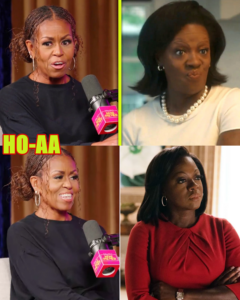
 When Viola Davis first appeared onscreen as Michelle Obama in Showtime’s The First Lady, the internet reacted instantly — and intensely.
Within minutes of the series premiere, social media exploded with clips, memes, reaction videos, and heated debates focused largely on one surprisingly specific detail: Davis’ portrayal of the former First Lady’s facial expressions and speaking mannerisms. In particular, viewers became fixated on the actress’s exaggerated lip movements, which quickly went viral across TikTok, X, Instagram, and YouTube.
For days, online commentary ranged from playful impersonations to harsh criticism, with some viewers calling the performance “brilliantly nuanced” while others labeled it distracting and overly theatrical.
But amid the internet storm, one question lingered above all others:
What did Michelle Obama actually think about it?
Now, according to sources close to both women and insiders familiar with the former First Lady’s reaction, Michelle Obama’s real feelings about Viola Davis’ highly discussed portrayal are far more thoughtful — and far less dramatic — than the internet may assume.
And perhaps unsurprisingly, Michelle’s response says just as much about her character as it does about the performance itself.
“Michelle understands the pressure Viola was under,” one insider familiar with the situation explained. “She never approached it from a place of mockery or offense. She viewed it as an artist interpreting another public figure, which is an incredibly difficult thing to do.”
The portrayal itself was always destined to face extraordinary scrutiny.
Michelle Obama is not merely a recognizable public figure — she is one of the most globally admired women of the 21st century. Her voice, posture, expressions, cadence, and public image have become instantly identifiable to millions around the world.
Capturing someone so familiar presents a unique challenge even for performers as accomplished as Viola Davis.
And Davis, an EGOT-winning actress widely regarded as one of the finest talents of her generation, approached the role with obvious seriousness and preparation.
Still, no amount of preparation could have fully anticipated the internet’s reaction.
The memes came fast.
Clips zooming in on Davis pursing her lips circulated endlessly online, often accompanied by humorous captions and side-by-side comparisons to Michelle Obama’s real-life interviews. Comedians and influencers quickly joined the conversation, further amplifying the viral moment.
For many actors, such widespread online mockery could feel devastating.
But according to insiders, Michelle Obama herself reportedly maintained a notably compassionate and measured perspective.
“She knows what it’s like to become a meme,” a source close to the former First Lady shared. “Michelle has spent years being caricatured, analyzed, and scrutinized publicly. She doesn’t take that kind of thing lightly.”
Indeed, throughout Barack Obama’s presidency, Michelle Obama faced relentless public examination over everything from her fashion choices to her body language, speech patterns, and facial expressions.
Observers frequently projected assumptions onto her demeanor — often through racialized or gendered lenses — making her especially sensitive to the pressures public women endure under constant scrutiny.
That awareness reportedly informed how she viewed Davis’ performance.
“Michelle appreciates effort and authenticity,” the insider explained. “She understood Viola was trying to capture emotional essence, not just surface imitation.”
That distinction matters deeply within acting circles.
Celebrity portrayals often walk a precarious line between impersonation and emotional interpretation. Some performances prioritize exact mimicry, while others focus more heavily on internal psychology and emotional truth.
Viola Davis appeared to aim for the latter.
In interviews promoting The First Lady, Davis emphasized that she was less interested in delivering a simple impression and more focused on understanding Michelle Obama’s humanity beneath the public image.
“She’s iconic, but she’s also a woman,” Davis explained during one promotional appearance. “I wanted to understand her vulnerabilities, her strength, her loneliness at times.”
Yet the internet’s attention rarely settled on those subtleties.
Instead, much of the discourse became dominated by clips reduced to seconds-long moments optimized for virality. Nuance disappeared. Context vanished. Performance analysis transformed into meme culture almost overnight.
For Michelle Obama, however, sources say the broader conversation surrounding the portrayal proved more interesting than the memes themselves.
“She’s fascinated by how social media changes public reaction,” one insider claimed. “A performance can become a global joke within hours now, regardless of the deeper work behind it.”
That phenomenon increasingly defines modern entertainment culture.
Television performances are no longer evaluated solely by critics or awards voters. Instead, they are dissected in real time across social platforms where short clips often shape entire narratives detached from full-context storytelling.
Viola Davis became the latest high-profile example of that dynamic.
Despite winning widespread praise for emotional scenes throughout the series, online discussion repeatedly returned to a handful of viral moments. The performance itself became fragmented into memeable pieces.
Still, insiders insist Michelle Obama never joined the ridicule.
“She has enormous respect for Viola Davis,” a source said plainly. “That never changed.”
The admiration between the two women reportedly predates The First Lady entirely.
Over the years, Michelle Obama has publicly praised Viola Davis’ career and contributions to storytelling, particularly regarding representation for Black women in Hollywood. Davis, meanwhile, has often spoken about Michelle Obama with profound admiration, describing her as inspirational, graceful, and historically significant.
That mutual respect reportedly helped frame Michelle’s reaction to the series.
“She knows Viola approached the role with sincerity,” the insider added. “And Michelle values sincerity more than perfection.”
Interestingly, some critics and scholars later argued that the backlash toward Davis reflected broader unrealistic expectations audiences place on portrayals of highly familiar public figures.
Unlike historical characters viewed through distance, Michelle Obama remains vividly present in contemporary public life. Audiences possess deeply fixed ideas about her identity, making any artistic interpretation particularly vulnerable to criticism.
“You’re not just competing with memory,” one television critic explained at the time. “You’re competing with YouTube clips, documentaries, interviews, memes, speeches — endless real-life footage.”
That challenge becomes even more difficult when portraying someone as culturally beloved as Michelle Obama.
For many Americans, she represents intelligence, warmth, elegance, resilience, and authenticity simultaneously. Deviating even slightly from public expectations can trigger immediate backlash.
Yet despite the controversy, many viewers defended Davis passionately.
Fans praised her emotional depth, vulnerability, and willingness to take creative risks rather than deliver a safer, more superficial imitation. Some argued the viral mockery itself reflected the increasingly unforgiving nature of internet culture.
“People forget actors are making interpretive choices,” one supporter posted online during the height of the debate. “This isn’t Saturday Night Live.”
Viola Davis herself eventually addressed the criticism directly in interviews.
“It hurts when people say negative things,” she admitted candidly. “But not everything is going to be awards-worthy to everyone.”
Her honesty resonated widely within the industry.
Actors and directors rallied around Davis, emphasizing the courage required to portray iconic real-life figures under modern social media conditions. Many noted that even legendary performers face brutal online scrutiny today.
Michelle Obama reportedly understood that reality well.
“She knows public criticism can become deeply personal very quickly,” an insider said. “She has empathy for anyone navigating that level of exposure.”
That empathy may stem partly from Michelle’s own complicated relationship with public perception.
Throughout her years in the White House, she carefully balanced approachability with discipline, warmth with professionalism, and emotional openness with political caution. Every gesture carried symbolic weight.
Even after leaving Washington, Michelle Obama remains among the world’s most analyzed women.
Her interviews generate headlines. Her fashion choices trend online. Her speeches are dissected politically and culturally. Like few modern public figures, she occupies a unique space where celebrity, politics, symbolism, and personal identity intersect constantly.
Seeing another woman attempt to carry and recreate that complexity onscreen reportedly gave Michelle greater appreciation for Davis’ effort.
“She knows there’s no simple way to portray someone living under that level of public attention,” the source explained.
Behind the scenes, insiders say Michelle was ultimately less focused on internet memes and more appreciative of the broader intention behind The First Lady itself.
The anthology series aimed to humanize presidential spouses often flattened into symbolic roles by history. Alongside Michelle Obama, the show explored Betty Ford and Eleanor Roosevelt, highlighting the personal sacrifices and private struggles experienced inside the White House.
For Michelle, sources say that mission mattered.
“She believes stories about women’s inner lives are important,” the insider shared. “Especially women who are often reduced to public images.”
Ironically, the viral discourse surrounding Davis’ portrayal sometimes seemed to reinforce exactly the kind of superficial analysis the series attempted to challenge.
Rather than discussing Michelle Obama’s emotional experiences, much of the internet focused narrowly on facial expressions and delivery style.
Some commentators later criticized that reaction as emblematic of modern online culture’s tendency to flatten complex performances into digestible jokes.
“We consume media through clips now,” one cultural analyst noted. “And once a narrative takes hold online, it becomes incredibly difficult to shift.”
For Viola Davis, the narrative surrounding The First Lady became permanently intertwined with memes — despite many critics later reassessing the performance more positively after revisiting the series in full.
Meanwhile, Michelle Obama reportedly never publicly commented in detail partly because she wanted to avoid fueling further controversy.
“She had no interest in embarrassing Viola or contributing to negativity,” the insider explained. “That’s simply not who she is.”
That restraint aligns closely with Michelle Obama’s broader public persona.
Throughout years of political and cultural polarization, she has consistently projected diplomacy, measured language, and emotional intelligence even when facing criticism personally.
Her famous phrase “When they go low, we go high” became one of the defining slogans of modern American political culture precisely because it reflected her approach to conflict.
Sources say that philosophy extended naturally to how she viewed the viral performance debate.
“She believes people deserve grace,” one insider said.
Still, the controversy surrounding The First Lady also sparked meaningful conversations about representation, artistic freedom, and audience expectations.
Many Black actresses publicly defended Viola Davis while discussing the additional scrutiny often directed toward Black women portraying powerful historical figures. Others noted that audiences sometimes expect impossible perfection from portrayals involving beloved public icons.
“People wanted Michelle Obama herself,” one entertainment journalist observed. “But acting isn’t cloning.”
In retrospect, the debate may reveal more about modern audience behavior than about Davis’ actual performance.
The internet increasingly rewards exaggeration, mockery, and instant reaction over slower, more nuanced evaluation. Viral moments dominate attention cycles regardless of artistic complexity.
And once a meme forms, it can overshadow months or years of serious creative work.
Yet despite everything, Viola Davis emerged from the controversy with her industry reputation firmly intact.
Hollywood insiders widely continued viewing her as one of the era’s most gifted performers, while many fans eventually revisited the series with greater appreciation for its emotional ambition.
As for Michelle Obama, sources suggest she ultimately viewed the entire situation with perspective rather than outrage.
“She understands that public art invites public reaction,” the insider explained. “But she also believes empathy should exist within criticism.”
That mindset perhaps reflects why Michelle Obama remains such a uniquely admired figure across cultural and political lines.
Even amid controversy surrounding her own portrayal, she reportedly prioritized understanding over defensiveness.
And according to those familiar with her thinking, Michelle never interpreted Viola Davis’ performance as disrespectful — even when internet commentary became harsh.
Instead, she saw an acclaimed actress attempting something extraordinarily difficult under impossible levels of public scrutiny.
Which, in many ways, mirrors Michelle Obama’s own experience in public life.
Both women have spent years navigating spaces where expectations are immense, criticism is constant, and every expression can become symbolic overnight.
Perhaps that shared understanding explains why Michelle reportedly responded not with anger or embarrassment, but with compassion.
In today’s outrage-driven media environment, that reaction may be the most remarkable detail of all.
Because while social media transformed Viola Davis’ performance into a viral spectacle, Michelle Obama appears to have viewed it through a far more human lens.
Not as a meme.
Not as a controversy.
But as one woman attempting to honor another through art — however imperfectly the internet may have judged the result.
News

¡SE HA LIADO EN DIRECTO! LA TELEVISIÓN DEL CORAZÓN Y LA CONSTRUCCIÓN DEL CONFLICTO EN TORNO A ALEJANDRA RUBIO, CARMEN BORREGO Y TERELU CAMPOS
Cómo los programas de entretenimiento convierten cada gesto familiar en un fenómeno viral de alcance nacional Madrid. La televisión del…
¡DENUNCIAS E INSULTOS! EL UNIVERSO MEDIÁTICO QUE RODEA A ISA PANTOJA, ALEXIA RIVAS E ISABEL PANTOJA EN LA TELEVISIÓN DEL CORAZÓN
Cómo la prensa del entretenimiento convierte cada gesto, declaración o silencio en un episodio de alto impacto público Madrid. La…

MILLONARIO ESCÁNDALO: EL CICLO INFINITO DEL CONFLICTO MEDIÁTICO EN TORNO A Belén Esteban Y Alba Carrillo EN EL ENTORNO TELEVISIVO DE Antonio David Flores Y Rocío Carrasco
Cuando la televisión del corazón convierte la vida privada en narrativa pública y la polémica en estructura permanente de entretenimiento…

¡SE HA LIADO! LA TENSIÓN MEDIÁTICA TRAS LAS ÚLTIMAS POLÉMICAS QUE ENVUELVEN A Alejandra Rubio, María José Campanario Y Kiko Hernández
El ecosistema del entretenimiento español, la amplificación de los conflictos y el impacto de las narrativas virales en la televisión…

TERRIBLES DENUNCIAS! EL FIN DE UNA ERA TELEVISIVA Y EL NUEVO ESCENARIO DE LA TELEVISIÓN DEL CORAZÓN TRAS Jorge Javier Vázquez, María Patiño Y María Jesús Ruiz
El cierre de una etapa, la reconfiguración del entretenimiento y la transformación del lenguaje mediático en España Madrid. El final…

¡EXPLOTA TODO! EL EFECTO TELEVISIVO DE LA POLÉMICA CONSTANTE EN TORNO A Carmen Borrego, Alejandra Rubio Y EL PAPEL DE LOS PLATÓS DE ENTRETENIMIENTO
Cómo los programas de actualidad transforman tensiones familiares y mediáticas en narrativas de alto impacto televisivo Madrid. La televisión de…
End of content
No more pages to load